Ten math problems that had never been published anywhere. Four frontier AI systems turned loose on them. Seven of the ten came back with at least one essentially flawless solution.
The computing bill for all of that ran somewhere between tens and a few hundred dollars. A strong PhD student could burn three years on a single one of these problems and count the time well spent.
Those numbers appear in a new paper by Terence Tao, the Fields Medalist, on what mathematics looks like in the age of AI (arXiv:2608.16753). If you expected the best mathematician of his generation to throw a party, that is not what this is. His actual question is less comfortable: when AI can do the math, what exactly is a mathematician for?
Five rungs from “solved” to “understood”
Tao’s move is to stop treating “solved it” as the finish line. He breaks the job into five rungs, each one slower and more human than the last.
Rung one: produce solutions to as many open problems as possible. Fine, but volume alone gets you piles of wrong answers. An AI that sprays solutions differs little from a grad student padding a CV.
Rung two: verify correctness. Formal proof assistants can check every line now, so this rung is increasingly handled by machines.
Rung three is where it gets interesting: a proof a human can actually understand. AI proofs, Tao observes, tend to be too smooth. Every step checks out, every gap is bridged, nothing anywhere resists you. That sounds like quality. To a mathematician it reads as a defect.
Human proofs carry friction on purpose. A good writer stops at the hard turn and explains why this path and not that one, admits which step is not obvious, leaves the scaffolding standing so the next person can climb. Tao’s image: an AI proof drops you on the summit by helicopter; a human proof walks you up the mountain and points out the cave, the shortcut, and the other peak worth seeing while you are up there.
Rung four, the community has to accept the result: journals, referees, seminars, all the machinery no single author or machine controls. Rung five, the slowest and the most valuable, is canonization. Getting a theorem published is a moment. Getting it into the textbooks is a process that takes years and other people.
Proof indigestion
The coinage at the center of the paper is “proof indigestion.”
For most of its history, mathematics ran on proof scarcity. Hard problems everywhere, proofs rare, every genuine result precious. The field’s whole infrastructure, from journals to peer review to how students are taught, was engineered around that scarcity.
AI flips the table. Proofs will arrive faster than mathematicians can verify, explain, review and absorb them. The intake valve is wide open and the digestive tract has not changed. The bottleneck stops being producing mathematics and becomes digesting it.
If that sounds dramatic, remember this field has been here before. The foundational crisis of the 1920s set Hilbert against Brouwer over what mathematics even stands on. That fight gave the world Gödel, Turing and von Neumann. The crisis did not destroy math. Math got deeper by answering it.
Tao’s bet is that the new crisis rhymes with the old one, except the crack now runs through the values and practice of research rather than the foundations. His tactical move is clever. Do not argue about whether AI can do research-level math; grant it as a working hypothesis, then ask the orthogonal question. If the machine can do the math, what should the humans do?
If you can’t explain it, don’t publish it
Part of his answer is one principle, stated from an ICM stage: if you cannot explain your result clearly, you should not publish it. Even with the formal checker showing green.
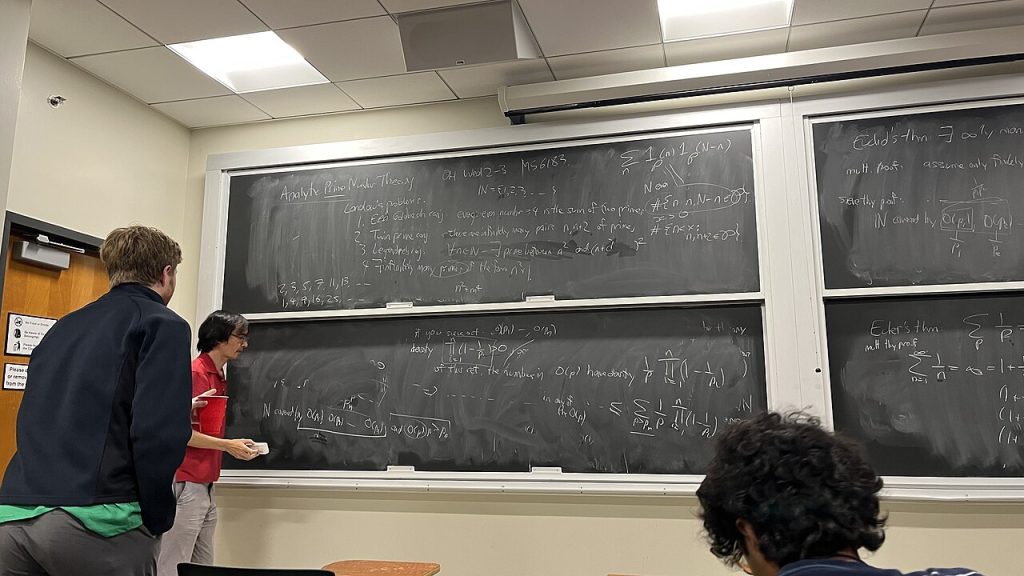
That is a direct hit on the attitude already spreading through the field. The model proved it, Lean verified it, I cannot walk through every step, but it is correct, so ship it. Tao says no. And he is not posing as someone above the tools. He says outright that he uses AI for literature search, text autocomplete and making figures. Use them. Just stay someone who can stand at the blackboard and account for every step.
The Leiden Declaration on AI and Mathematics, published in June 2026, lands on the same line. AI may join the work. Humans own the result.
The blank that matters
Tao also put a fill-in-the-blank conjecture on screen: within ___ years, at ___ cost, with ___ human oversight, AI will complete ___ of research-level tasks in ___ areas of mathematics, with ___ success. Whether you write five years or fifty, he would say you missed the point. The blank that matters cannot be filled with a number: why are you doing math at all?
If the answer is getting your name on a theorem, margins on that business are collapsing fast. If it is understanding why the world holds together this way, that was never the machine’s job. Thurston said it decades before this paper: we are not theorem-producing machines; the purpose of proof is understanding.
I watch AI move into one knowledge field after another, and math is the cleanest preview of the whole story. Not because mathematicians are special, but because their output can be checked. Everywhere else we will keep arguing about quality long after the machines match the volume. Math just gets there first, with the best possible tour guide.
Source paper: arXiv:2608.16753. Photo: Natecation / Wikimedia Commons, CC BY-SA 4.0.